WELCOME TO OUR BLOG!

Here are some words about our current Mantle of the Expert work, which is with a class of year 4 students.

In this Mantle of the Expert unit the children are in role as a team of earth scientists who work in a fictional company called 'Geo Ready' (modelled on New Zealand’s real crown institute ‘GeoNet’).

Working in this role children will have jobs and tasks to complete that will lead to learning about:

a. New Zealand’s geological hazards: volcanos, earthquakes, and tsunami

b. Scientific equipment used to measure land movement/activity

c. How earth scientists at 'GeoNet' decide where to place their different monitoring systems. In making these decisions children will have to consider things such as types of land forms and rocks in an area, environmental factors such as weather, read maps, investigate history of land, look at old land records, and investigate land ownership and explore ways to seek permissions from land owners.

The work will involve inquiry research, writing in a range of genres including letter writing and report writing, reading a range of materials including lots of map-work covering a variety of keys and scales, and mathematical skills including measuring, and diagram/graph work.

We hope you enjoy sharing our learning journey and the discoveries we make! You can also read past learning journeys by selecting from 'Previous Mantle of the Expert Work at Muritai School', which is a tab on the right hand side of this blog page.


Detail from a map of Wellington geology

Sorting rocks

27 August 2012

DAY SEVEN


IN ROLE AS ARCHAEOLOGISTS

Our Dig Site!


Today we went on another excavation.  We set up our dig site, using masking tape to mark out our dig squares.  In each square an ‘artifact’ was placed upside down to be uncovered.  Before anyone 'uncovered' an artifact we played at being archaeologists.  This was lots of fun.  Everyone chose a square to work in and everyone had their tool kits and log books for recording their finds.  

Using their archaeology tool kits everyone selected tools to start their excavation work.  Looking around you could see what tools everyone was using by how they were moving – the drama was impressive, everyone stayed in role really well.
Using small brushes.

Digging and using a camera.

Using a measuring tape.

UNCOVERING OUR ARTIFACTS

Then everyone FROZE!  I shoulder tapped children in each square and that was their cue to ‘uncover’ their artifact.  This worked really well and the acting again was fantastic.  Once the group in each square had uncovered their artifact and discussed  some initial responses to what it might be they froze again and we listened to another square find their artifact.


When all the artefacts had been 'uncovered' we all went back into role and everyone started work on recording information about their find in their archaeology log books.


BACK IN THE LAB


All the artefacts were taken back to the lab for further research. Our discoveries today gave us the starting point for another round of inquiry work.  Everyone was busy researching and recording information in their log books.  It was great to listen to how much everyone has learned about ancient Greek artefacts already.  All the artefacts today were new but everyone drew on the knowledge and language from our term's work to interpret what they had found.

The group are starting to sound like real archaeologists!

Inquiry work back in the lab.
Here is a list of the artifacts we uncovered today:

  • 3 pottery amphoras showing sporting practice/exercises with servants playing music while they worked.

  • Caryatids (lady columns) on the “Porch of Maidens” from the Erectheion on the Acropolis in Athens.  These columns were sculpted in the Golden Age by Phedias who also worked on the famous sculpture, Athena Parthenos, that we studied earlier.

  • A marble sculpture of Greek Wrestlers from about 510BC.  We did some inquiry around how wrestling was part of everyday life for the ancient Greeks and how school boys were taught wrestling along with reading, writing, and maths. 
  • A piece of pottery, perhaps a vase or bowl, showing the God Dionysus and a Satyr. We did some inquiry around this God and how he was represented in artworks with a fennel staff and a wreath of grape vines – being god of wine, music, and parties!  We also learnt about how satyrs were part goat and often followed the god Dionysus playing panpipes.  We will be able to add this information to the guides we have been writing on Greek Gods and Mythical Creatures.
  • Pottery jars being used as a water clock.  We knew all about water clocks from our play in the agora/pnyx last week!
  • Pieces of pottery showing Greek armour.  We did some inquiry around Greek soldiers and the types of armour they used.  We found out that the ancient Greek soldiers were called Hoplites.  Their round shield was called an ‘aspis’, their spear was called a ‘dory’, the short sword was called a ‘xiphos’, and they wore plumed Corinthian helmets with cheek plates.
  • A bronze relief sculpture showing Odysseus hiding under a ram.  It was fun working out what this statue was showing, as we all know a lot about Odysseus now!  This was a bronze relief ornament from the Sanctuary of Apollo at Delphi, c. 540-530 BCE 
  • A piece of pottery showing Odysseus blinding the Cyclops – Polyphemus.  We are starting to see how artists often depicted stories of Greek heroes and gods/goddesses on their pottery.  This painting was done on a type of pottery called a proto – attic amphora, ca. 650BC. 

THE ODYSSEY - THE FINAL EPISODES

Today we finished listening to the final episodes of the Odyssey.  We heard how Odysseus finally made it to his homeland Ithaca (after twenty years away!) and about the challenges he had getting back into his home and ruling as King again.  With the help of the goddess Athena, Odysseus finally got his home back and was left to live in peace with his wife Penelope and son Telemachus. 

We have loved the Odyssey adventure!  Alana finished our storytelling with “Odysseus must be related to Harry Potter he is “THE BOY THAT LIVED!”.

Here are some of the story map illustrations that were drawn today:

Nausicaa helps Odysseus
Odysseus is sailed home to Ithaca by the Phaeacians.
Athena presents herself to Odysseus and warns him of trouble in his home.
Athena turns Odysseus into a beggar for disguise.
Penelope is saddened by all the suitors who want to marry her!
Penelope weaving at her loom - she unravels it each night so she doesn't have to make her decision! 
Odysseus successfully bends his bow and arrow and shoots an arrow through the holes in the back of twelve axe heads.  Everyone knows Odysseus has returned and the suitors are defeated.

23 August 2012

DAY SIX


Agora at the end of the 5th century BC


Today we spent the day as Athenians of the golden age in the agora (marketplace).  We began by doing some inquiry research about the agora.  In pairs we read some fact sheets, compared maps of the Athenian agora in the 5th and 4th centuries BC, and looked at some artists’ illustrations of what the agora might have looked like in the golden age.
We answered the following questions:
1. what sorts of things might you buy and sell in the agora?
2. what kinds of people might spend time in the agora?
3. what activities might go on in the agora?

We also created two sentences of conversation that might be overheard in the agora.

We then gathered all our ideas together onto large sheets of newsprint, synthesising our information.  We had to note what each other had discovered and recorded to make sure we didn’t double up on information.
Organising ideas.


We then used these sheets of newsprint to plan how we could transform the classroom into an ancient Athenian agora.  I had no pre-plan of how this part was going to go, it was to be the children's creation - I would be there to guide and help if needed.  Abigail suggested we start with a plan of where everything would go in the classroom so labels were made for the different types of stalls and areas in the agora and these labels were placed around the classroom.  Once we had a rough layout for our agora everyone chose what kinds of people they were going to be.  Everyone then went off to the different areas to create their stalls/areas.  The classroom quickly became a buzz of imagination and creativity.  We had:

-slave traders and slaves
-a blacksmith making weapons
-food stalls selling bread, meat, fruit, and vegetables
-a flower stall
-a pizzeria stall owner
-a pottery stall selling amphoras
-a clothes and shoemaker stall selling chitons and sandals
-a water fountain
-the Pnyx area for speeches
-a sign for the Port of Piraeus and a trireme in the port
-the Athenian mint where silver was being made into coins.

Stalls were filled with produce, conversations written, speeches to be delivered at the Pnyx were written, statues put up, a trireme in port drawn, and a water fountain was created.

Amphoras, coins, and weapons were drawn in amazing detail using images we had come across in our work as archaeologists, items of clothes were correctly labelled as chitons (tunics), sandals and himations (cloaks), likely pizza toppings had to be looked up (Hawaiian probably unlikely!). Someone asked about the kinds of money that would have been used and so we did some research and learnt about tetradrachms (equivalent to a handful of silver) and obols (a sixth of a tetradrachm). 
Athenian coins with the symbol of the owl.
Finlay's trireme in the Port of Piraeus.
A lot of new inquiry work arose out of our play today and it was fun being able to apply so much of our new knowledge from the last few weeks – we have all learned a lot!  Conversations between housewives picked up on the limited rights of women in ancient Athens.  There were speeches delivered at the Pnyx about how to spend the new found silver at Laurion drawing on new learning about triremes/war strategy, and Pericles’ ideas for the beautification of Athens.  There was even a speech written about the system of ostracisizing citizens with ostracons and another about increasing the rights of slaves.  A water clock was made to time the speeches too (Leon was our water clock and he poured water from one container to the other to time each speech!).

READY!  THE AGORA IS OPEN – LET THE TRADING BEGIN!

First we used the convention of a Circular Drama where we watched parts of our market come alive.  We listened to some speeches in the Pnyx, watched a slave trade, and overheard some conversations between a couple of housewives collecting water from the fountain.

Two housewives collecting water at the fountain - carrying amphoras on their head that they purchased from the pottery vendor.

Slave Market.
Pericles speaking at the Pnyx (Leon is the water clock!)
Hello citizens of Athens, my name is Pericles and I love to speak to you!  I think we should have a lot less violence to make our city very beautiful.  We should make statues and new buildings for our beautiful city because a beautiful city equals a popular city.  (clapping for audience) Thank you! Thank you!"

Themistocles speaking at the Pnyx (Leon is the water clock!)
 “Hello, my name is Themistocles and I speak for you people.  I think we should spend money on good things.  Things to protect us from war.  Now that we have found silver from the mines at Laurion I think we should build 200 more triremes for protection in wars  (clapping from audience) Thank you!  Thank you!
Ancient Athenian Ostrakon.
We should get rid of Leonardo because he robbed us!  Please vote now!  He deserves to be sent away!  We need to ostrasize him.  We need to write his name on 6,000 pieces of pottery to send him away for ten years.  (clapping from audience).  Thank you!  Thank you!” (Another speech at the Pnyx).

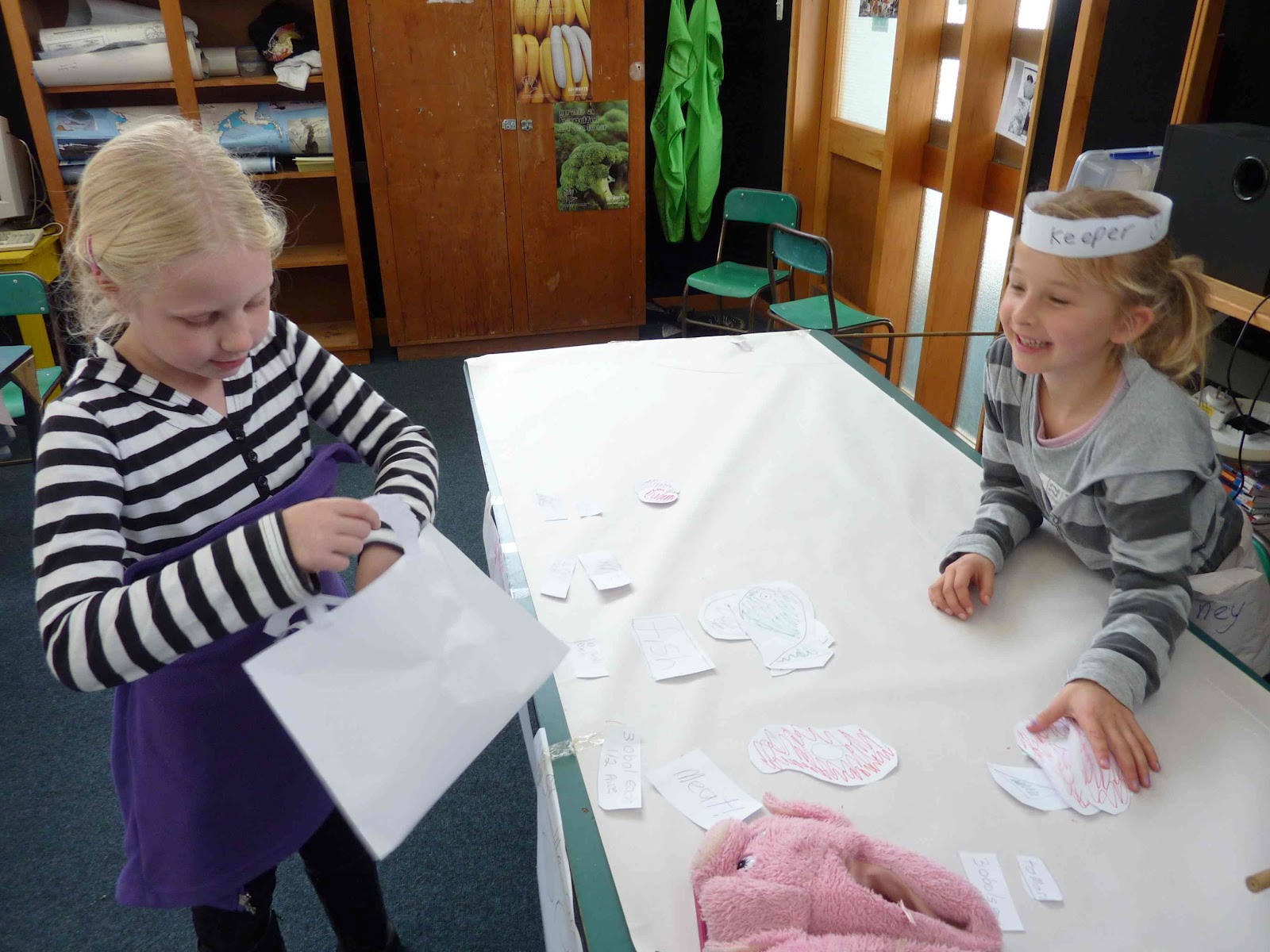
Then we played in our market, all getting into role and visiting each others stalls to buy and sell things.  There were handbags of tetradrachms and obols which were used to purchase food, flowers, weapons, clothes, pottery, and pizzas!  Lots of fun!

Ready to shop!
A housewife with her new slave.
Blacksmith - Weapon Shop


Flower Stall
Pottery Stall

Food Shopping
Taking pizza orders
Shopping


13 August 2012

DAY FIVE

TRIREMES AND TRADING SHIPS

Today we started with some inquiry work on:
  • the Athenian naval fleet of warships called ‘triremes’ (boats that had 3 tiers of oarsmen), 
  • the Port of Piraeus, and 
  • Athenian trading ships. 

We learnt about Themistocles and how he was an excellent strategist and leader of the Athenian naval fleet during the Golden Age.  Themistocles was responsible for establishing the Port of Piraeus as a successful navy base.  He was responsible for having 200 more triremes built when Athens discovered silver at Laurion.  He was also responsible for building major fortifications at the Port of Piraeus.  There were defensive walls all around the port and long walls running all the way from the port of Piraeus to Athens!


We also looked at maps showing the trade routes of ships from Athens around the Mediterranean during the Golden Age.  We discovered that the Athenians during the Golden Age traded things such as pottery, silver and gold vessels, olive oil, wine (carried in amphoras), and textiles.  


Click on the link 'Athenian Navy' under the heading 'Websites for our Mantle' on the right hand sidebar to see a you tube with images and words about the Athenian naval fleet of triremes.

Following our inquiry work we then created representations of the two different types of ships using ourselves, chairs, and newsprint (and some bamboo sticks that were found in the corner of the classroom!).  This was a great creative exercise with the teams working together to generate ideas, use their imaginations, and problem solve to best create a representation of the boat, (finding the best way to represent 3 tiers of oars was a good challenge!)

Representation of an Ancient Greek trading ship with a cargo of amphoras in the centre.   Evie is the mast and sail.


Representation of trireme with the prow for ramming out the front and the three tiers of oars.  The other Evie is the mast and sail and Olivia is the pipe blower keeping everyone rowing in time.
CONTINUING WITH THE STORY OF THE ODYSSEY

Next we continued listening to the story of Odysseus and making our story maps.  We listened to how:
  • Odysseus’s men were punished for eating the sacred cattle of the sun on the island of Thrinacia, 
  • Odysseus then lived with Calyspo on the island of Ogygia for 7 years, 
  • The gods then decided to let Odysseus return home and sent Hermes to tell Calyso she must release Odysseus.  
  • Poseidon then got angry, when he saw Odysseus on the sea once again trying for home, and sent a storm to destroy his ship and
  • Odysseus was saved by the nymph Ino, who in the likeness of a gull, lent him her immortal scarf.
Below are some of the illustrations that were drawn on our story maps today.

The sacred cattle of the sun on the island of Thrinacia

Zeus sends a thunderbolt to destroy Odysseus's ship after the men hunt one of the sacred cattle of the sun, despite  Odysseus's warnings.

Hermes the messenger god.

Hermes the messenger god.

Hermes arrives on Ogygia to tell Calypso to release Odysseus and let him return home.
Poseidon (still angry with Odysseus for blinding is son the Cyclops) wrecks Odysseus's boat as he tries to sail home.
The nymph Ino comes in the form of a gull to help Odysseus get to land safely by giving him a scarf of immortality.

AN INTERESTING NEW LINK

In Search of the Goddess Athena’.  
I have just added a link to a digital application that allows you to ‘walk’ through the Acropolis museum in search of representations of the goddess Athena.  We have been learning a lot about this goddess who was the goddess of wisdom in war and patron goddess of Athens.  Click on the link 'Acropolis Museum - search for Athena' under the heading 'Websites for our Mantle' on the right hand sidebar.  If the site comes up in Greek you can change it to English by clicking ‘English’ at the bottom of the screen.  


DAY FOUR

ARCHAEOLOGICAL LOG BOOKS: RECORDING THE DETAILS OF OUR FINDS
Today we began with looking at how archaeologists record their findings.  Everyone was given their own ‘Archaeologist Log Book’ and we had a go at recording a find.  We had to make sure we recorded exactly where the thing was found (i.e. what square it was found in), we drew a picture of the find, classified it as either artifact/feature/midden/skeleton, and then wrote a detailed description of the find.

Here is an entry that we share wrote for a Panathenaic Amphora. 

Part of an entry from one of the archaeological log books for the Panathenaic Amphora.

‘This artifact is a pottery Panathenaic amphora.  It was given as a prize at the Panathenaic Games, which was held every four years in Athens in the Golden Age (479-431BC).  The lady on the vase is the goddess Athena.  She was the goddess of wisdom in war and she was the goddess of Athens.  They put olive oil in these to give to the winners.’              
                                  Shared writing.

AN ARCHAEOLOGICAL DIG!
Next we headed out on an 'excavation'!  We used string to set up our dig site and we labelled each square so we would be able to record where we found things.  We 'excavated' (by agreeing to believe that when we turned over an image we had 'dug it up') a stone sculpture that we then had to do some research about.  Read some of the entries that were made in our Archaeologists log books below.


Our Archaeological Dig Site!
Part of an entry from one of the archaeological log books for the sculpture of the Contest of Athens.
This is a sculpture on the West Pediment of the Parthenon.  It represents the contest, Athena versus Poseidon.  Cecrops was the first king of Athens and the judge.  Poseidon gave a salt water spring.  Athena gave an olive tree.  Athena won.’ By Professor Finlay: Archaeological Scientific Illustrator.

This is a stone sculpture of the goddess Athena and Poseidon competing in a competition for Athens.  Their sculptures are on top of the Parthenon in Athens.  The sculptures have been made and carved out of stone.  For Athens Poseidon gave a sea but sadly it was salty.  Athena gave olive trees and won and that’s how it ended.’ By Auriel: Arhaeological Zoologist.

Poseidon gave a sea water lake but that was a useless gift.  Then Athena gave the town an olive tree, which gave oil, olives, and wood.  So Athena won.’  By Dr Kai: Underwater Archaeologist.

This is a stone sculpture of Athena and Poseidon having a context for who will be the ruler of Athens.  Athena said she would gift a big olive tree and Poseidon said he would make a stream.  The people lived the idea of the stream but they drank some water and it was salty!  So they chose Athena.  Poseidon was so mad he flooded the area around Athens.  By Professor Parker: Archaeological Scientific Illustrator.

This is a human made feature on the West Pediment of the Parthenon.  It is a stone statue of the goddess Athena competing in a challenge against Poseidon for the city of Athens.  If you didn’t already know the Parthenon has a twelve metre high statue of Athena because she won the contest with her gift of an olive tree.  Poseidon gave them a salt water stream.’  By Cella: Archaeological Scientific Illustrator.

You can click on the link on the right hand sidebar ‘Contest for Athens’ to hear a telling of this myth.  This link is under the heading ‘Websites for our Mantle’.


CONTINUING WITH THE ODYSSEY
In the afternoon we continued listening to the story of Odysseus and making our story maps.  We listened to how Odysseus faced the bewitching enchantress Circe, successfully got his ship and men past the mesmerising songs of the sirens, and then how they faced the six headed monster Scylla and the water gulping Charybdis.  Here are some illustrations from our story maps.

Circe the Enchantress - turning Odysseus's men into swine.
Circe the Enchantress - Odysseus asks Circe to turn the swine back into his men.

Odysseus is tied to the mast and his men's ears are blocked with softened beeswax so as not to be lured by the songs of the sirens.


Odysseus and his men have to sail between the rocks of the six headed monster Scylla and the sea gulping Charybdis.


1 August 2012

DAY THREE


A MYSTERY PERSON
When we arrived in class today there was an outline of a head on the board with a question mark on it.  “Who is that?” “Is it a God?” “Is it Odysseus?” “Is it a Greek hero?.  There was a buzz of suggestions and ideas put forward from the group.

I presented the group with some images and objects from a bag that all had something to do with our mystery person on the board.  The group looked carefully at the images and gathered their ideas.

he looks like a war leader
he is an orator (makes speeches)
he is from Athens – the Acropolis is behind him in the picture
those letters look like they might be his name
he must have been rich and famous to have statues of him made

Gathering our Ideas about Pericles

Next we split into small groups to read some information about this person, whose name we learnt was Pericles.  Each group shared back some key information about Pericles:

  • Athens was a powerful and rich city in the Golden Age and Pericles was the leader of the city.

  • Pericles was well educated, intelligent, and a good speaker.

  • Pericles led the city not as a dictator but used democracy (voting – letting the citizens have their say in how the city was run).

  • Pericles led a big building project on the Acropolis, he wanted to make Athens beautiful and repair all the damage done in the Persian Wars.

  • Pericles led the building of the Parthenon with its 12 metre high statue of Athena made of gold and ivory.

  • Pericles wanted the building work to provide jobs for many citizens in Athens.

  • Pericles lead changes in government included a law that said all Athenian citizens must have two Athenian born parents.  This gave more people rights as many of the wealthy people of Athens had married out of Athens.

  • Pericles was a big supporter of the arts, theatre, and music.

  • Pericles believed that all people should be well educated and have military training.
COLLECTIVE CHARACTER OF PERICLES
Next we made a collective character of Pericles.  Leon stood in the centre to represent Pericles and the rest of the group took turns to stand behind him and speak aloud possible ideas and thoughts of Pericles.  When someone had read their idea out they sat down and someone else stood up to take their place.  This was quite effective!


I want people to be more happy and to give me more ideas
I want Athens to be the most beautiful polis (city)
I think it’s about what we do, not who we are that is important
 I think everybody should have the opportunity to have a good job and good money
I love plays and art
I really want my city to be the most beautiful in the world
I want all the people of Athens to be well educated
I love being a politician
Athens is a beautiful city of art and theatre and music.  It is a thinking house
I think Athens is the best city
I think everyone should be able to vote
I think we should live in harmony with other cities

A SMALL COMMISSION
After morning tea I shared a letter with the group.  The letter was from Sophie the archaeologist (a character from a book we read in our first session ‘Archaeologists Dig for Clues’).  Sophie was writing to us for some help.

Dear Team,

I am writing to you in the hope that you might be able to help me and my team of archaeologists understand some artifacts we recently excavated.

Last month we finished a big dig in the Mediterranean near Athens in Greece.  We found a number of artefacts that we believe date back to about 460BC.  We need to present our findings from the excavation at a conference at the end of August but our team does not have much knowledge or expertise about artifacts from this time. We have heard that your team specialises in artefacts from the Golden Age of Athens so we hope you can help us!  We have five artifacts and questions that we need help with (see pictures and questions enclosed).

We look forward to hearing from you soon,

From Sophie (From ‘Archaeologists Dig For Clues’).

We divided into groups to work on the different questions and to write letters back to Sophie with the information she might need.  This required gathering the knowledge we had learnt already and  then looking up other references for more information/detail.

Groups are looking at Panathenaic Amphoras, Athenian coins, sculptures of Athena, Athenian armour, and a piece of pottery with the name of Pericles inscribed on it.  As the groups set to work to analyse their artifact it was impressive how much everyone has already learnt about the Golden Age, it was great to hear so many “aha/I know!” moments.

We will finish these letters next week.

FREEZE FRAMES
Our last activity of the day was to settle down and listen to the next part of the story of the Odyssey.

We listened to the story of King Aeolus and his sack of winds and added this part of the story to our story maps.


Because Samantha had been away last week we decided to make some Freeze Frames with narrators, to tell the story of Odysseus that we had listened to so far.  Each person in the freeze frame was allowed to speak aloud one sentence as well as having one group narrator.  Each group then performed their small freeze frame.  The performances were very fun and entertaining – there are some budding actors and keen performers amongst us!

1. Paris comes across the three goddesses, Athena, Aphrodite, and Hera, arguing about who is the most beautiful.

2. Two men hide inside the wooden horse.  King Menelaus wants his wife back!  Helen and Paris inside Troy.

3. The Cyclops is given wine by Odysseus and then blinded.  The other Cyclops come to his aid but leave again when they hear that “no man” has blinded him!

4. One of Odysseus’s men letting the wind out of the sack while Odysseus sleeps.