WELCOME TO OUR BLOG!

Here are some words about our current Mantle of the Expert work, which is with a class of year 4 students.

In this Mantle of the Expert unit the children are in role as a team of earth scientists who work in a fictional company called 'Geo Ready' (modelled on New Zealand’s real crown institute ‘GeoNet’).

Working in this role children will have jobs and tasks to complete that will lead to learning about:

a. New Zealand’s geological hazards: volcanos, earthquakes, and tsunami

b. Scientific equipment used to measure land movement/activity

c. How earth scientists at 'GeoNet' decide where to place their different monitoring systems. In making these decisions children will have to consider things such as types of land forms and rocks in an area, environmental factors such as weather, read maps, investigate history of land, look at old land records, and investigate land ownership and explore ways to seek permissions from land owners.

The work will involve inquiry research, writing in a range of genres including letter writing and report writing, reading a range of materials including lots of map-work covering a variety of keys and scales, and mathematical skills including measuring, and diagram/graph work.

We hope you enjoy sharing our learning journey and the discoveries we make! You can also read past learning journeys by selecting from 'Previous Mantle of the Expert Work at Muritai School', which is a tab on the right hand side of this blog page.


Detail from a map of Wellington geology

Sorting rocks

26 September 2012

DAYS TEN AND ELEVEN

MONDAY
On Monday we did some inquiry learning about Ancient Greek architecture.  We learnt about the different types of columns (Doric, Ionic, and Corinthian), friezes, metopes and triglyphs, and pediments.  Then we did some detailed study of the most famous building on the Acropolis, The Parthenon.  We looked at the layout of the Parthenon, the types of columns (Doric on the outside and Ionic on the inside), the metope/triglyph frieze, and the stories sculpted in the pediments: the contest for Athens on the West and the birth of Athena on the East.  We looked at how the frieze around the building showed a Panathenaic Procession and the offering of the peplos robe to Athena (we knew about the Panathenaic Games from our earlier study and this was the procession that was held at the opening of these games).  And we already knew all about the 12 metre high gold and ivory statue of Athena inside the Parthenon! 

Then we talked about how we would set up our next drama play, which was going to be the opening of the Parthenon in 438BC.  We made a collective plan about who would be at the opening and what events might happen.  Then everyone chose what parts they would like to play and started to prepare their roles.  It was decided that there would be a table of gods watching the opening, a restaurant on Mt Olympis serving the gods, speeches by Pericles (the leader of Athens) and Phidias (the sculptor), entertainers, traders, and townspeople with offerings for Athena.

Preparing roles.

Erin shows everyone how it took 9 years to build The Parthenon - working in BC time can be tricky!


WEDNESDAY
This was the last day of our Mantle of the Expert Ancient Greece unit. 

We began the day looking at architectural features of modern day buildings in Wellington that have been influenced by the artists and designers of Ancient Greece in the Golden Age.  We saw Doric columns on the Railway Station, Ionic columns on the Parliament buildings, Corinthian columns on the town hall, and Doric columns and pediments on St Andrews on the Terrace.  We even saw one building that had a triglyph and metope frieze around the top. 

Doric columns on the Wellington Railway Station
Corinthian columns on the Wellington Town Hall
We then spent the morning finishing our preparations for the opening of the Parthenon.  Costumes and props were organised and the room layed out as the area around the Parthenon. The whiteboard was the front of the Parthenon and the columns, metope/triglyph frieze, and pediment showing the contest for Athens between Athena and Poseidon was drawn.

Drawing the Parthenon
THE OPENING OF THE PARTHENON
Once everything was prepared we used circular drama to watch all the different things that were happening as part of the opening of the Parthenon.  First we listened to conversations between the townspeople who had come to see the new building.

Two women who have come to see the opening of the Parthenon.

“I have bought a sack of obols for Athena and jars of olive oil” (these were presented to a very pleased Athena, Poseidon was not happy!).

“Isn’t it wonderful!  Did you bring the sacrifices?” (a number of chickens and sheep were presented to Athena!).

Then we heard speeches from Pericles and Phidias officially opening the Parthenon, watched over by guards.
Pericles officially opens The Parthenon.
“Hello loyal citizens.  Today we are here for the opening of the Parthenon.  Today we need to thank some people. First of all we would like to give great thanks to Phidias the great man who built this wonderful building.  Second of all we would like to thank the wonderful designers Kalamis, Ictinus, and Calibrates.  Thirdly I would like to thank all of you for agreeing to build this wonderful building.  Finally I would like to thank the beautiful goddess Athena for being the god of Athens and in your honour we have built a twelve metre statue of you!  We have tried to make this the most beautiful building in Athens and hope you like it.  Thank you.” PERICLES

“I’m honoured to be here to present the Parthenon with our 12 metre gold statue of Athena.  We love our goddess Athena …we may have to keep away from Poseidon today though….!”  [note: because he didn’t win the contest for Athens!].  PHIDIAS

Then we watched the gods for a while feasting at the Mt Olympus restaurant ‘Gods Olympus’.  They were talking about the new building and Athena was very happy about the huge statue they had made of her.  Hermes carried messages between the gods and Poseidon was very grumpy at all the celebrating of Athena (since he had lost the contest for Athens) and moodily ate his shrimp!

Serving the gods at the restaurant 'Gods Olympus'.
Athena and Poseidon
Finally we watched entertainers perform music, songs, and dances.  Everyone got tickets to the wonderful performance by BAGS (Bennet, Abigail, Georgie, and Samantha).
BAGS entertains


When we had taken turns to watch the different activities we had time for some free play in the scene.  The gods came down in disguises to Athens to participate in trading and watching the entertainments, and everyone admired the new building. There was a lot of creativity in the play today and the children showed they had learnt a lot!


THE BIG DIG
After lunch everyone chose one friend to come and spend the afternoon as archaeologists.  We had 30 squares to dig in today all filled with artifacts that we have studied throughout our unit of work.  The Mantle children told their friend as much as they could about each artifact they dug up.  They shared their toolkits and archaeological log books with their friend and showed them all about working in role.
Our dig site!

The dig begins.
In each square there was also one quiz question about the Golden Age of Ancient Greece.  The winners of this quiz were….LEON and LACHLAN (you can collect your choc fish from Mrs Skilton tomorrow – well done!). 


PRIZEGIVING
To celebrate the end of our unit of work we had a prizegiving.  We did this with all of our friends there to watch.  Everyone received a certificate, their storymaps of the Odyssey, their logbooks, and their toolkits to take home.  Well done everyone, it has been lots of fun and I am very impressed with how much you have all learnt about the Golden Age of Ancient Greece, Homer’s Odyssey, and archaeology – you have all become real experts!

REFLECTIONS

We also did some reflection work today.  Here are some favourite moments and comments about Mantle of the Expert this term.

“I love Mantle and I would love to be chosen again.  I loved every week of it.  I also thought it was very fun.  I think I know more that my mum now.”


"I loved it when we were doing the play of the Parthenon opening.  I was Athena!"
"My favourite moment was the slave trade."
"My favourite thing was doing clay"
"I think that Mantle has been really fun and I would love to do it again"
“I like Mantle of the Expert.  I like this way of learning.  It helps me remember things and it’s a fun way of learning.  I think I learnt lots.  I would love to be chosen for Mantle of the Experts again next year.” 
"I love all the art, drama, and writing.  I learned LOADS about Ancient Greece.  I wish I could keep doing Mantle until Yr 8.”
"I wish Mantle was going for ever and ever and ever.  I hope I get chosen again"

10 September 2012

DAY NINE

BEING SCULPTORS


As archaeologists in this Mantle of the Expert unit we have studied many artefacts that were sculpted in stone and pottery in the Golden Age of Ancient Greece.  We have seen a lot of relief sculpture where the pictures are carved in to stone so that they stand out.  We have seen this style of sculpture on Ancient Greek buildings including The Parthenon and The Erecthion, often in the form of friezes that go around the building.  The goddess Athena, goddess of Athens and Odysseus’s saviour, is also the goddess of crafts including pottery and sculpting.  So…

today we had a go at being sculptors.  We worked with clay to make a series of tiles to illustrate the story of the Odyssey, which we are now all experts on!  We learnt a lot about how to work with clay using different tools, with lots of problem solving and creativity along the way.

MAKING TILES

First we had to roll out clay and cut our tile shapes.  We used long straight pieces of wood to make straight sides and a ruler and knife to cut out our square.  We then used a special potters tool to make grooves in the back of our tile so it would not curl when it dried.  We also made two holes in the top so it would be able to be hung on a wall.


HAVNG A GO AT RELIEF SCULPTURE

Next we worked with small bits of clay to sculpt our pictures.  We used our plans from last week as a guide but had to do lots of experimenting to see how best to make our pictures work.  We used toothpicks and other clay tools.  We also made slip (a mixture of clay and water) to attach pieces on to our tile.  We learnt how potters attach handles to cups by scratching grip marks onto the handle pieces and the cup before using slip like glue to attach it.  We experimented with this method until we got our relief work looking how we wanted it to.


SOME OF OUR TILE CREATIONS

Six Headed Scylla
Odysseus's Boat
Goddess Athena puts a stop to any more fighting.
Odysseus with his great bow ready to shoot through the holes of 12 axe heads.
Hermes the messenger god - with wings on his feet.


3 September 2012

DAY EIGHT


ARCHAEOLOGY LOG BOOKS
This morning we spent time finishing writing in our Archaeology Log Books about the artefacts we had uncovered last week.  We are going to be using this information in our archaeology work in the last couple of weeks of the term, so we needed to make sure we had all our information recorded carefully and accurately. 

PLANNING FOR CLAY RELIEF TILES
Next week we are going to be working with clay to make some tiles in ‘relief’ style.  ‘Relief’ is a style of sculpture that adorned many of the buildings on the Acropolis in Athens in the Golden Age, especially on friezes around the tops of buildings such as the Parthenon.  We have looked at a few examples of this type of sculpting in our work as archaeologists and we looked at a few more examples today.

An example of a relief style sculpture.
This relief sculpture shows the Goddess Athena.

We talked about what we might be able to show on a series of 20 tiles (making one each).  We quickly agreed that we could tell the story of the Odyssey, using our story maps as a planning guide.  We collectively planned how the story could be represented on 20 tiles and then someone suggested picking numbers out of a hat to allocate a part of the story to each person. 

When everyone had been allocated a part of the story we all went off to plan our tiles. First we agreed on what the size of our tiles would be, (16cm x 16cm), then we worked out what our main shapes would be that would stand out in the ‘relief’ style.  We cut these shapes out to use as templates next week and we also planned what details we would add using tools such as toothpicks. We are now all ready to work with clay next week.


ATHENA
We ended the day listening to the story of how Athena was born out of the head of Zeus – wearing full hoplite armour including an aspis (shield) a dory (spear), and a plumed Corinthian helmet.  We also read about how Athena is not only the goddess of wisdom and strategy in war, but also the goddess of craftsmanship including pottery and sculpting.  Someone made the suggestion that we should call on Athena next week to help us with our clay tile work!

27 August 2012

DAY SEVEN


IN ROLE AS ARCHAEOLOGISTS

Our Dig Site!


Today we went on another excavation.  We set up our dig site, using masking tape to mark out our dig squares.  In each square an ‘artifact’ was placed upside down to be uncovered.  Before anyone 'uncovered' an artifact we played at being archaeologists.  This was lots of fun.  Everyone chose a square to work in and everyone had their tool kits and log books for recording their finds.  

Using their archaeology tool kits everyone selected tools to start their excavation work.  Looking around you could see what tools everyone was using by how they were moving – the drama was impressive, everyone stayed in role really well.
Using small brushes.

Digging and using a camera.

Using a measuring tape.

UNCOVERING OUR ARTIFACTS

Then everyone FROZE!  I shoulder tapped children in each square and that was their cue to ‘uncover’ their artifact.  This worked really well and the acting again was fantastic.  Once the group in each square had uncovered their artifact and discussed  some initial responses to what it might be they froze again and we listened to another square find their artifact.


When all the artefacts had been 'uncovered' we all went back into role and everyone started work on recording information about their find in their archaeology log books.


BACK IN THE LAB


All the artefacts were taken back to the lab for further research. Our discoveries today gave us the starting point for another round of inquiry work.  Everyone was busy researching and recording information in their log books.  It was great to listen to how much everyone has learned about ancient Greek artefacts already.  All the artefacts today were new but everyone drew on the knowledge and language from our term's work to interpret what they had found.

The group are starting to sound like real archaeologists!

Inquiry work back in the lab.
Here is a list of the artifacts we uncovered today:

  • 3 pottery amphoras showing sporting practice/exercises with servants playing music while they worked.

  • Caryatids (lady columns) on the “Porch of Maidens” from the Erectheion on the Acropolis in Athens.  These columns were sculpted in the Golden Age by Phedias who also worked on the famous sculpture, Athena Parthenos, that we studied earlier.

  • A marble sculpture of Greek Wrestlers from about 510BC.  We did some inquiry around how wrestling was part of everyday life for the ancient Greeks and how school boys were taught wrestling along with reading, writing, and maths. 
  • A piece of pottery, perhaps a vase or bowl, showing the God Dionysus and a Satyr. We did some inquiry around this God and how he was represented in artworks with a fennel staff and a wreath of grape vines – being god of wine, music, and parties!  We also learnt about how satyrs were part goat and often followed the god Dionysus playing panpipes.  We will be able to add this information to the guides we have been writing on Greek Gods and Mythical Creatures.
  • Pottery jars being used as a water clock.  We knew all about water clocks from our play in the agora/pnyx last week!
  • Pieces of pottery showing Greek armour.  We did some inquiry around Greek soldiers and the types of armour they used.  We found out that the ancient Greek soldiers were called Hoplites.  Their round shield was called an ‘aspis’, their spear was called a ‘dory’, the short sword was called a ‘xiphos’, and they wore plumed Corinthian helmets with cheek plates.
  • A bronze relief sculpture showing Odysseus hiding under a ram.  It was fun working out what this statue was showing, as we all know a lot about Odysseus now!  This was a bronze relief ornament from the Sanctuary of Apollo at Delphi, c. 540-530 BCE 
  • A piece of pottery showing Odysseus blinding the Cyclops – Polyphemus.  We are starting to see how artists often depicted stories of Greek heroes and gods/goddesses on their pottery.  This painting was done on a type of pottery called a proto – attic amphora, ca. 650BC. 

THE ODYSSEY - THE FINAL EPISODES

Today we finished listening to the final episodes of the Odyssey.  We heard how Odysseus finally made it to his homeland Ithaca (after twenty years away!) and about the challenges he had getting back into his home and ruling as King again.  With the help of the goddess Athena, Odysseus finally got his home back and was left to live in peace with his wife Penelope and son Telemachus. 

We have loved the Odyssey adventure!  Alana finished our storytelling with “Odysseus must be related to Harry Potter he is “THE BOY THAT LIVED!”.

Here are some of the story map illustrations that were drawn today:

Nausicaa helps Odysseus
Odysseus is sailed home to Ithaca by the Phaeacians.
Athena presents herself to Odysseus and warns him of trouble in his home.
Athena turns Odysseus into a beggar for disguise.
Penelope is saddened by all the suitors who want to marry her!
Penelope weaving at her loom - she unravels it each night so she doesn't have to make her decision! 
Odysseus successfully bends his bow and arrow and shoots an arrow through the holes in the back of twelve axe heads.  Everyone knows Odysseus has returned and the suitors are defeated.

23 August 2012

DAY SIX


Agora at the end of the 5th century BC


Today we spent the day as Athenians of the golden age in the agora (marketplace).  We began by doing some inquiry research about the agora.  In pairs we read some fact sheets, compared maps of the Athenian agora in the 5th and 4th centuries BC, and looked at some artists’ illustrations of what the agora might have looked like in the golden age.
We answered the following questions:
1. what sorts of things might you buy and sell in the agora?
2. what kinds of people might spend time in the agora?
3. what activities might go on in the agora?

We also created two sentences of conversation that might be overheard in the agora.

We then gathered all our ideas together onto large sheets of newsprint, synthesising our information.  We had to note what each other had discovered and recorded to make sure we didn’t double up on information.
Organising ideas.


We then used these sheets of newsprint to plan how we could transform the classroom into an ancient Athenian agora.  I had no pre-plan of how this part was going to go, it was to be the children's creation - I would be there to guide and help if needed.  Abigail suggested we start with a plan of where everything would go in the classroom so labels were made for the different types of stalls and areas in the agora and these labels were placed around the classroom.  Once we had a rough layout for our agora everyone chose what kinds of people they were going to be.  Everyone then went off to the different areas to create their stalls/areas.  The classroom quickly became a buzz of imagination and creativity.  We had:

-slave traders and slaves
-a blacksmith making weapons
-food stalls selling bread, meat, fruit, and vegetables
-a flower stall
-a pizzeria stall owner
-a pottery stall selling amphoras
-a clothes and shoemaker stall selling chitons and sandals
-a water fountain
-the Pnyx area for speeches
-a sign for the Port of Piraeus and a trireme in the port
-the Athenian mint where silver was being made into coins.

Stalls were filled with produce, conversations written, speeches to be delivered at the Pnyx were written, statues put up, a trireme in port drawn, and a water fountain was created.

Amphoras, coins, and weapons were drawn in amazing detail using images we had come across in our work as archaeologists, items of clothes were correctly labelled as chitons (tunics), sandals and himations (cloaks), likely pizza toppings had to be looked up (Hawaiian probably unlikely!). Someone asked about the kinds of money that would have been used and so we did some research and learnt about tetradrachms (equivalent to a handful of silver) and obols (a sixth of a tetradrachm). 
Athenian coins with the symbol of the owl.
Finlay's trireme in the Port of Piraeus.
A lot of new inquiry work arose out of our play today and it was fun being able to apply so much of our new knowledge from the last few weeks – we have all learned a lot!  Conversations between housewives picked up on the limited rights of women in ancient Athens.  There were speeches delivered at the Pnyx about how to spend the new found silver at Laurion drawing on new learning about triremes/war strategy, and Pericles’ ideas for the beautification of Athens.  There was even a speech written about the system of ostracisizing citizens with ostracons and another about increasing the rights of slaves.  A water clock was made to time the speeches too (Leon was our water clock and he poured water from one container to the other to time each speech!).

READY!  THE AGORA IS OPEN – LET THE TRADING BEGIN!

First we used the convention of a Circular Drama where we watched parts of our market come alive.  We listened to some speeches in the Pnyx, watched a slave trade, and overheard some conversations between a couple of housewives collecting water from the fountain.

Two housewives collecting water at the fountain - carrying amphoras on their head that they purchased from the pottery vendor.

Slave Market.
Pericles speaking at the Pnyx (Leon is the water clock!)
Hello citizens of Athens, my name is Pericles and I love to speak to you!  I think we should have a lot less violence to make our city very beautiful.  We should make statues and new buildings for our beautiful city because a beautiful city equals a popular city.  (clapping for audience) Thank you! Thank you!"

Themistocles speaking at the Pnyx (Leon is the water clock!)
 “Hello, my name is Themistocles and I speak for you people.  I think we should spend money on good things.  Things to protect us from war.  Now that we have found silver from the mines at Laurion I think we should build 200 more triremes for protection in wars  (clapping from audience) Thank you!  Thank you!
Ancient Athenian Ostrakon.
We should get rid of Leonardo because he robbed us!  Please vote now!  He deserves to be sent away!  We need to ostrasize him.  We need to write his name on 6,000 pieces of pottery to send him away for ten years.  (clapping from audience).  Thank you!  Thank you!” (Another speech at the Pnyx).

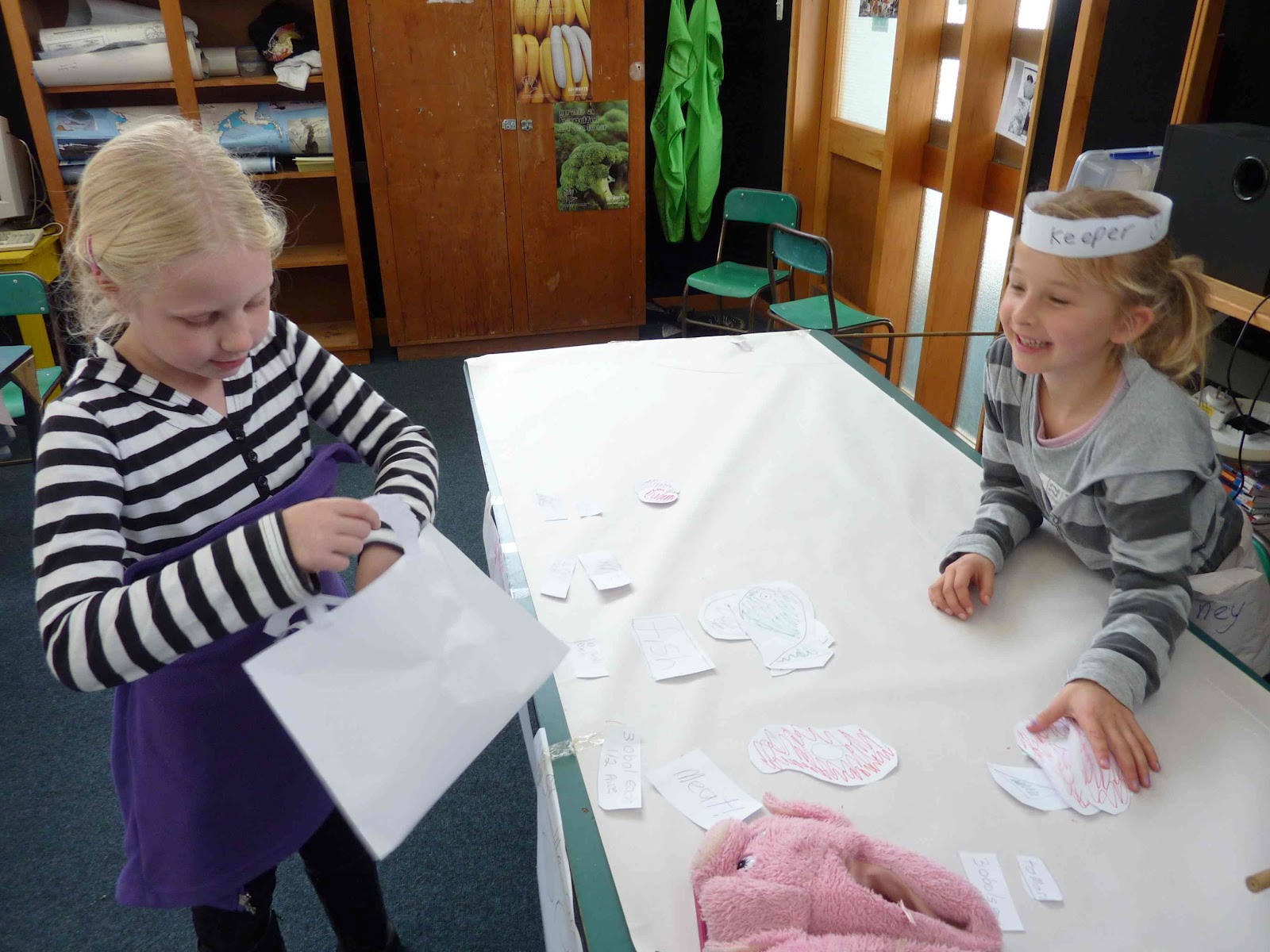
Then we played in our market, all getting into role and visiting each others stalls to buy and sell things.  There were handbags of tetradrachms and obols which were used to purchase food, flowers, weapons, clothes, pottery, and pizzas!  Lots of fun!

Ready to shop!
A housewife with her new slave.
Blacksmith - Weapon Shop


Flower Stall
Pottery Stall

Food Shopping
Taking pizza orders
Shopping